The Story of Our Town
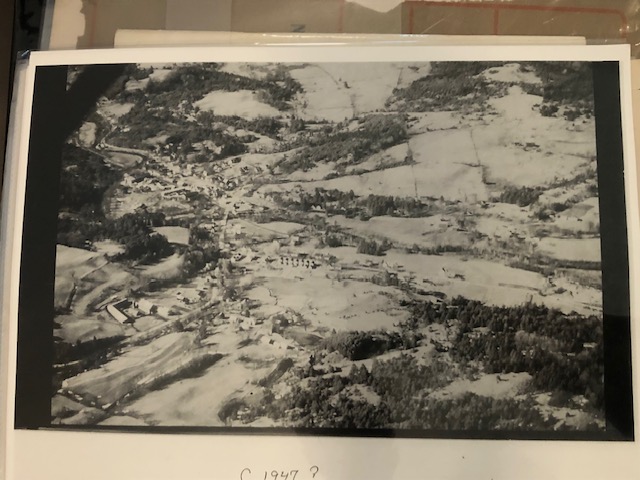
With the Connecticut located to along the east, and numerous ponds and streams located to the to the west, the town of Ryegate was once a critically important landscape for Native American peoples. Native American archaeological sites dating
from the Late Archaic period, ca. 6,000 – 3,000 years ago, through to the time of
European contact and beyond have been documented in Ryegate, and many more
likely remain undiscovered.
Benning Wentworth, governor of the Province of New Hampshire, chartered 23,040
acres in the southeast corner of Caledonia County to Richard Jeness and 93 associates
on September 8, 1763. This was the town’s first speculative real estate transaction.
None of the 94 grantees ever saw the land before it was conveyed for one thousand
pounds to John Church of Charlestown, New Hampshire in 1767. Church later sold the
tract to Reverend John Witherspoon, President of Princeton College.
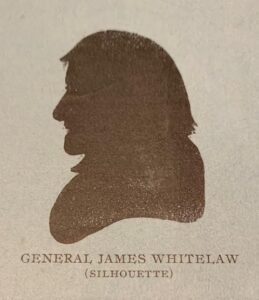
In 1773, James Whitelaw and David Allen, agents of the Scotch-American
Company, purchased the town from Dr. Witherspoon. Whitelaw’s survey of the area
remains the basis of local property boundaries. In his report to the Scottish investors, he
marveled at the fertility of the soil, the abundance of fish in the streams, and the
availability of water power for sawmills.
According to the New Hampshire Historical Society, the town was named Ryegate
in honor of Baron Reigate, a leading British naval figure and Royal Governor of
Jamaica.
Ryegate’s first Town Meeting was held in May of 1776, the first child was born in
1774, and the first marriage took place in January of 1777. The first buildings were at
Ryegate Corner, along the Bayley-Hazen Road, the only public highway connecting the
Wells River Valley with Barnet, Peacham, and Danville. A mail route was soon
established along this route, and the first Ryegate Postmaster was General James
Whitelaw.
The first school was at the site of what is now Blue Mountain Grange Hall. The town
was later divided into ten school districts. In 1914 and 1915, a two-year high school was
operated in South Ryegate. The District Schools were gradually phased out until only
South Ryegate, Ryegate Corner, and East Ryegate had grade schools, with high school
students attending schools of their choice in surrounding towns. In 1970 the Blue
Mountain Union School was built for students K-12 from the towns of Ryegate, Groton,
and the Village of Wells River.
Ryegate may be the only town in Vermont that has had only Presbyterian churches
since its charter. The first church, built in 1779, stood in Ryegate Corner at the site of
the current Town House. This Church was used by both Associated and Reformed
(Covenanter) Presbyterians. Through the years, dissident groups broke away and
constructed churches in Ryegate Corner, South Ryegate, and East Ryegate. The East
Ryegate church is now owned by the Historical Society.
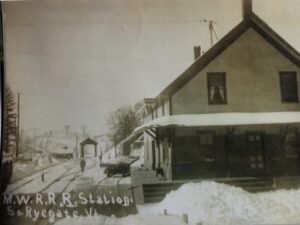
Railroads were an important factor in the growth and development of Ryegate. The
Connecticut and Passumpsic River Railroad began its route to St. Johnsbury in 1850,
and the first train of the Montpelier and Wells River Line traversed the Valley in 1873.
Farm products, lumber, grain, and thousands of bricks were shipped out of East
Ryegate.
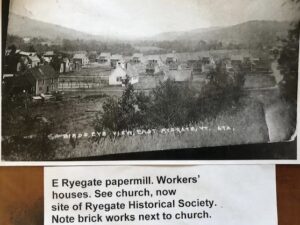
Pulp was shipped into the paper mill in East Ryegate beginning in 1906, and
millions of pounds of paper were shipped out. From the time it began operation until it
closed for the last time in 2001, the paper mill was one of the important industries in
town. At various points it produced high-grade news print, ribbon stock, light weight
catalog, photo mount, and tablets, to name a few. At its high point in the mid 1900s,
employment rose to 140.
In South Ryegate, the railroad allowed the development of the granite industry.
Quarries on Blue Mountain and White’s Hill supplied finishing sheds in the village. The
quarries gradually gave way to a superior grade of granite coming from the Barre area
and closed down completely in the 1930s. The Blue Mountain Quarry reopened briefly
from 1986 to 1991 and then, in May of 1993, McCullough Crushing purchased it from
the Small Business Association.
Agriculture has played an important role in the history of Ryegate. The early farms
were largely subsistence operations, but sold their surplus butter, lumber, and beef to
purchase goods, which could not be made on the farm. They also produced large
families of sturdy citizens, who have made their mark on the town and on many other
towns in this county. Agriculture continues to play an role in the economy and landscape
of the town. Farms are now fewer, larger, and more mechanized.
Construction on the Ryegate Wood Energy Plant on Route 5 in East Ryegate began
in 1991. The plant, completed in November of 1992, provides about 75 jobs and a
market for some of the low-grade timber, which is so plentiful in the area.
For those interested in an extensive and most interesting account of the history of
Ryegate, two volumes are recommended. The first is a History of Ryegate, Vermont
1774-1912 by Edward Miller and Frederic P. Wells, published in 1913, which can be
found on the town’s official web site: www.ryegatevt.org. Its sequel, The Down of the
Thistle – 20th Century Ryegate, Vermont, was written by Dwight A. White and published
in 2006. Both books are available for purchase through the Ryegate Historical Society.