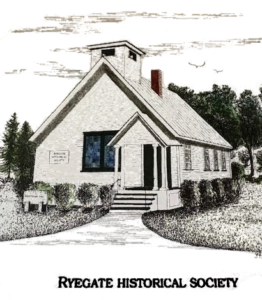
Welcome to a new season for the historical society! We’re happy to report that Whitelaw Hall has benefitted from some much-needed work. Finally, the ceiling is now secure and has brightened up the interior, which will be further enhanced with a new coat of paint; we have no idea of when the interior was last painted. A new porch floor and repairs to the front steps will be completed in time for this summer’s open house days. We are very grateful for all contributions, donations and memberships that enable us to take care of our building and collections.
You can imagine the work involved in moving everything inside of Whitelaw Hall in order for this work to be done; but there is a bright side to everything and you can expect a new look to the interior and collection displays when you come in to visit us this summer.
OPEN HOUSE DATES:
June 15th, July 20th, August 17th, September 21st and October 19th. From 10:00-12:00.
This continues our tradition of the 3rd Saturday of each month. We hope you’ll be able to join us and see the completed work and our new summer exhibit.
UPCOMING PROGRAMS
The Sleeping Sentinel: Deborah Jurist, president of the Groton Historical Society, will present a program on William Scott, who, along with 7 others from Groton enlisted in the third Regiment on June 1st, 1861. These untrained soldiers were disciplined and subjected to stern punishments, one of which was that any soldier found asleep on duty would be shot to death. William Scott was found asleep on duty on August 31st, court martialed in September and sentenced to a death warrant. What is his whole story? Come and listen to Deborah’s
presentation! We hope to hold this program in early September. More information to follow.
LAST MINUTE CHANGE! THIS EVENT HAS BEEN POSTPONED. WE WILL POST MORE INFORMATON ON A FUTURE LECTURE.
The History of Beekeeping: We will host a program which is supported by the Vermont Humanities Council, presented by Bill Mares on the History of Beekeeping. Bill, a writer and beekeeper for 45 years, will tell of the origins and evolution of beekeeping. He has been a reporter-photographer, state legislator and high school teacher. He has authored or co-authored 17 books and is a past-president of Vermont Beekeepers Association. In 2020 he co- authored, with Ross Conrad, The Land of Milk and Honey: a history of beekeeping in Vermont.
Additional Programming: As a culmination of our summer exhibit, we plan to
host an evening get-together where people can share their memories of early
school days in Ryegate. We’ll let you know the date.
THIS SUMMER’S EXHIBIT
RYEGATE’S SCHOOL HOUSES
We will have displays of photographs, school books and other school days’ memorabilia from the ten original one room school houses. With this in mind, we’re hoping that each of you will search your attics, basements and closets for anything you might have that would add to our exhibit. Whether it’s as a loan for the exhibit or a donation to our collection, we’d be delighted to receive and display your findings!
Please contact Linda Libuda: 802-584-3362.
NOTES ON EARLY SCHOOL DAYS:
There are early schoolhouse stories of lunches brought in lard pails, firewood having to be supplied by the families, water hauled from the closest spring, teachers living with students’ families, and meager salaries; there were long walks to school, no electricity and only outhouse facilities.
From the Miller and Wells History of Ryegate, we learned that the first public school in town was in General Whitelaw’s house, no date given, but c. 1790. How difficult it must have been to educate children who were scattered at great distances and would have only found their way to school “by rude paths among the woods.”
Other interesting snippets from the book: “People did not think that a woman could teach school any more than she could mow or chop wood.” But in the early 1800’s Abigail Whitelaw persuaded the committee to let her try and turned the tables; thereafter women were allowed to teach the summer session.
The summer school for 1810 began the middle of May and was taught four months, six days each week, for $16 for the term. About that time it was voted “That every person that sends to School shall for every Scholar they send find one half a cord of good wood ready cut for the fire.” There was a lack of books and the teacher had to make the quills with which to teach penmanship! Mr. Miller taught 26 days a month for 3 months for $10 a month and boarded with his pupils, boarding at 13 different places.
The first schoolhouse stood where the Grange now stands and was built about 1785. After several structures were replaced, a new two-room school was erected south of the parsonage. That building was burned in the 1941 fire and rebuilt as a one-room schoolhouse.
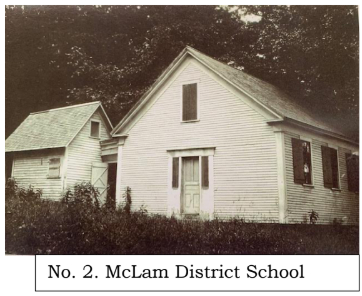
The McLam (No. 2) Schoolhouse was built on the North Bayley Hazen Rd (at the corner of Maple Drive) but later moved to the northwest corner of Meader Rd. It closed in 1925 and fell into disrepair.
No. 3, Park School, built in 1812 in the western part of town, eventually located on the east side of Hall Rd., opposite Park Drive; it closed in 1947 and later burned.
No. 4 Manchester, was built in 1814, located opposite and north by several hundred yards from the present power plant; it closed in 1933.
No.5 Whitelaw, built in 1816, one-half mile east of the second school, which was located opposite the intersection of S. Bayley Hazen Rd. & Whitelaw Rd.; this was the former location of a tavern operated by Robert Whitelaw. The school closed in 1952.
No. 6 North Ryegate was organized in 1817 and is still standing at the corner of Hall and Mosquitoville Roads. No. 7, Symes Pond, Gibson District, built in 1820, was located about 300 yards south of the McIndoe Falls end of Hunts Mill Rd. It closed in 1940; a foundation remains.
No. 8 South Ryegate, in 1821 was first a log building located on Creamery Rd. near Cowie Hill Rd. In 1888 a two-room school was built and in 1907 a second floor was added. It closed in 1970.
No. 9 Miller, located on Witherspoon Rd., west of the Arthur Whitehill farm, was built in 1840; it was replaced by a small building and operated as needed and later dismantled.
No. 10 East Ryegate Built in 1820 at the corner of East and Gibson Roads, later moved into E. Ryegate village. In 1914 a two-room school was built at the end of School Street and closed in 1967. This building is still standing.
COME AND LEARN LOTS MORE AT OUR OPEN HOUSE DAYS!
WISH LIST:
We have an almost complete collection of the Ryegate Town Reports but we’re missing the 1903 Town Report ! Does anyone have a copy and would be willing to contribute it to our collection?
MEMBERSHIP AND DUES:
Annual Membership:
Individual: $10/yr.
Family: $15/yr.
Lifetime Membership:
Individual: $100.
Family $125.
Dues are payable for a membership year of Jan. 1st-Dec. 31st.
Please make checks payable to:
Ryegate Historical Society, c/o Tim Wilson, Treasurer/ 979 Boltonville Rd./
Wells River, VT. 05081
Board Members: Tom Dole (584-3932), Molly Fisher (584-4292), Dover Ford
(592-3378), Linda Libuda (584-3362), George Murphy (584-3893), Marsha
Nelson (584-3667), Melvin Nelson (584-3638), Ginny Ross (584-3675), Peter
Sinclair (584-3280), Tim Wilson (584-3333).
Ryegate Historical Society
c/o. 3158 North Bayley Hazen Rd.
East Ryegate, VT. 05042